 United States Border Patrol/Supervisory Border Patrol Agent Abraham Garcia
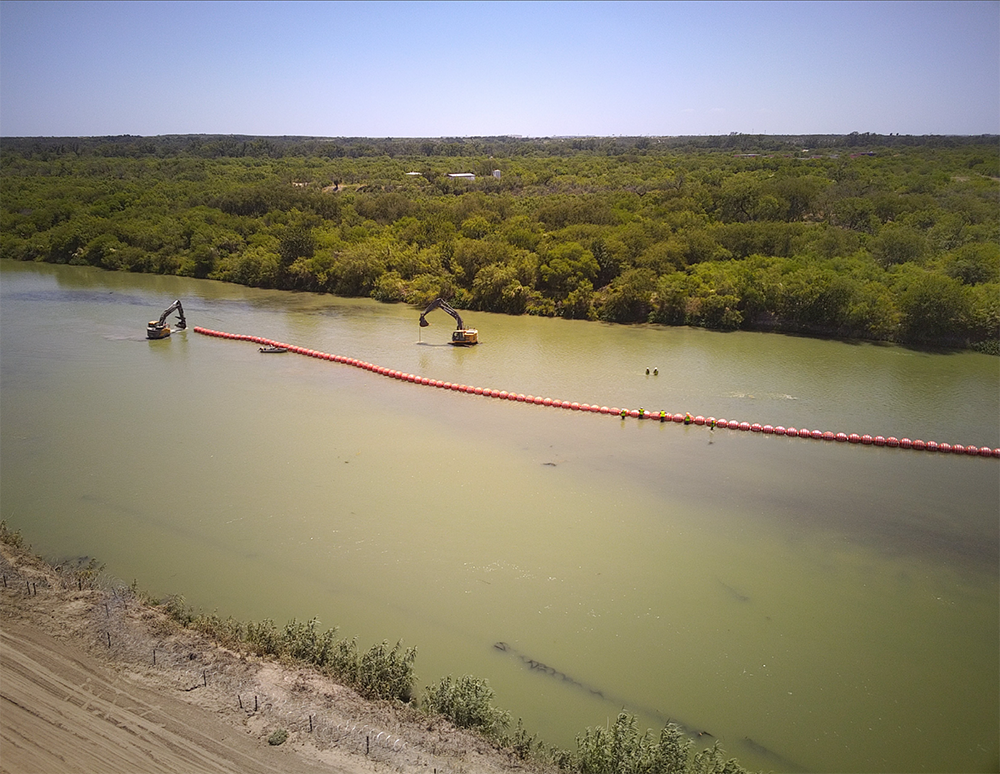
The American government announced this year that it plans to install approximately 536 miles, or about 862 kilometers, of cylindrical buoys along the Rio Grande, located in the southern part of the state of Texas. This measure would be imposed with the intention of mitigating the entry of immigrants, mostly Mexicans, into the country.
However, due attention was not given to the environmental impacts that such a proposal may generate for the location of its application. The region is already commonly impacted by floods, and the new structure may aggravate these occurrences. Despite statements that the barriers would not cause significant impacts, according to an informant from Customs and Border Protection (CBP), no evidence regarding the safety of the project has been presented.
Given the above, the lack of official publications about the action and, above all, of studies or reports on its possible impact, worries geomorphologists in the region regarding the possible repercussions on the river and its banks. In addition to the possible alteration of the river's flow, the difficulty for fishing, navigation and other practices, the accumulation of stranded debris can force the barriers and tear away part of the installation. In general, the Latino population of the region will be affected, either by the displacement from their origins or by the destruction of the natural landscape.
Previously, the Texas government had already used floating barriers in 2023. The adoption of the construction was permitted through an open bidding process during Trump's first term, and the action was widely discussed, triggering friction between local policies. The buoys also contained hazardous material in their assembly, challenging the safety of crossing the river, especially for immigrants crossing the border from Mexico. Thus, after a range of internal discussions, the Federal Court ordered the removal of the devices.
In this second Trump administration, the proposal is gaining momentum again under the command of the Department of Homeland Security (DHS). As early as 2025, numerous federal laws were suspended, including the National Environmental Policy Act (NEPA), the Endangered Species Act (ESA), the Migratory Bird Conservation Act (MAC), and the Safe Drinking Water Act.
In this context, private companies, many of which participated in the construction of border walls, received funding for the construction of the buoy chain without comprehensive oversight. The first buoys were installed on January 7th; however, the local population and activist groups continue to gather information to fight against the barrier and prevent the continuation of the construction, which has already accumulated more than $1 billion in investments.
Another important point to highlight is the possible transgression of treaties signed between neighboring countries, more specifically the 1970 treaty concerning the shared use of the river's waters and the delimitation of borders.
That said, the city of Brownsville, further south on the Rio
Grande, has stood out in terms of opposition to the project, including voting
on resolutions and protests. Furthermore, opposition from other counties has
followed the same line of reasoning, demanding updates and assertive
resolutions to avoid potential catastrophes.
Sources:
GARCIA, Berenice. Trump administration to
add 500 miles of migrant-deterring buoys along Rio Grande. The Texas
Tribune, [S. l.], March 23, 2026. Available at: https://www.texastribune.org/2026/03/23/texas-border-rio-grande-buoys-federal-barrier-brownsville/. Accessed on: Apr 7, 2026.
HERNÁNDEZ, Arelis R. et al. Border wall expansion: Trump environmental impact. The Washington Post, Washington, DC, March 21, 2026. Available at: https://www.washingtonpost.com/immigration/2026/03/21/border-wall-expansion-trump-environmental-impact/. Accessed on: Apr 7, 2026.